
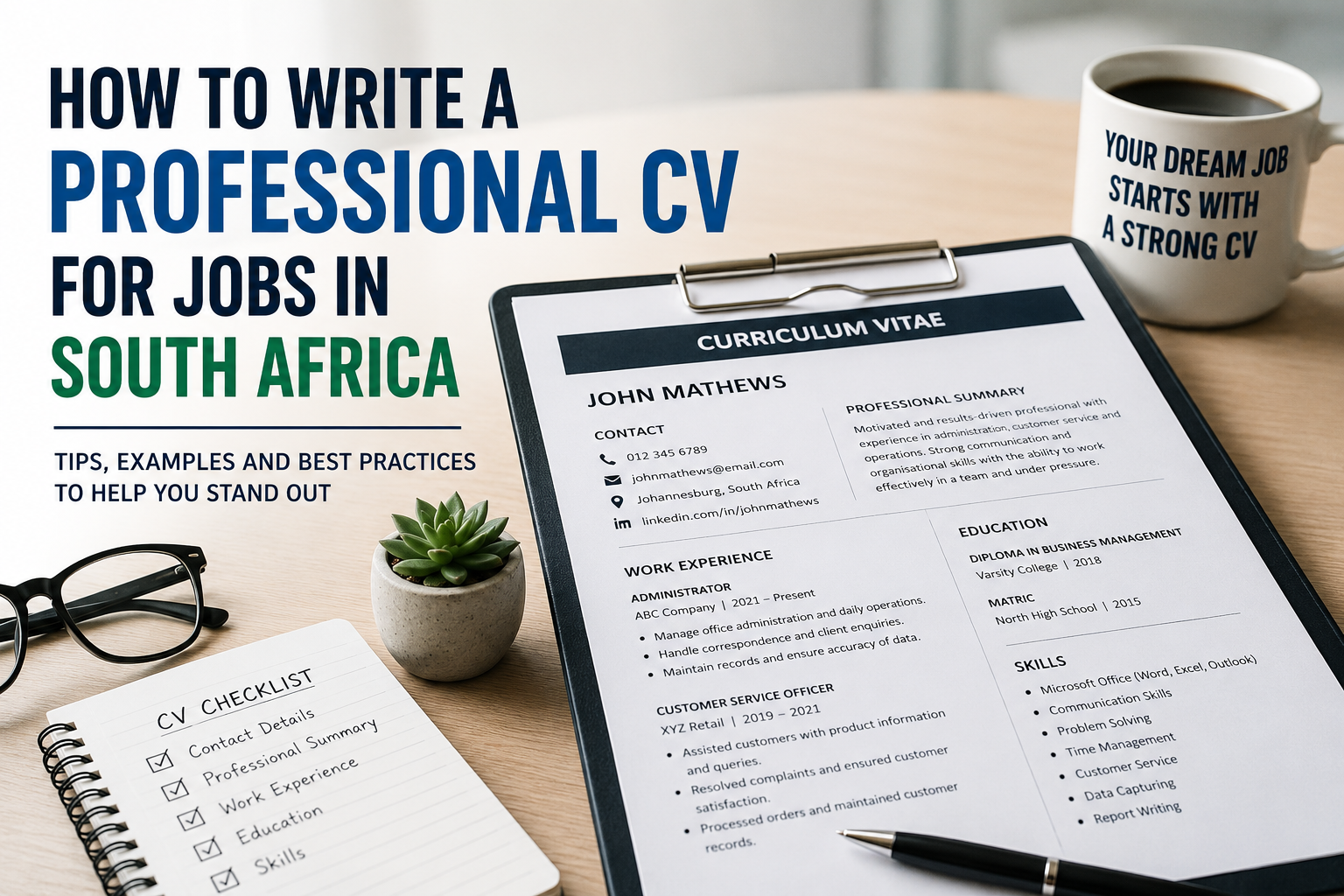
A professional CV is one of the most important documents you need when looking for employment in South Africa. It gives employers an overview of your qualifications, skills, work experience and suitability for a position.
A good CV does not guarantee that you will get a job, but it can make it easier for recruiters and employers to understand your background and decide whether you should be considered for the next stage of the recruitment process.
Whether you are applying for your first job, looking for an entry-level position, applying for a learnership or internship, changing careers or searching for a better opportunity, your CV should clearly present your genuine qualifications and experience.
This guide explains what to include in a CV, how to structure it, how to tailor it for different jobs and common CV mistakes to avoid.
What Is a CV?
CV stands for Curriculum Vitae.
A CV is a document that provides information about your professional and educational background. Employers use it to assess whether your experience, qualifications and skills are relevant to the position they are trying to fill.
A typical CV may include:
- Contact details
- Professional summary
- Work experience
- Education
- Qualifications
- Skills
- Licences and certifications
- Relevant achievements
- References, where appropriate
Your CV should provide enough information for an employer to understand your background without becoming unnecessarily long.
1. Start With Your Contact Details
Your CV should begin with your basic contact information.
Include:
- Full name
- Mobile phone number
- Professional email address
- City or general location
- LinkedIn profile, if relevant
Make sure your telephone number and email address are correct.
If an employer cannot contact you because of an incorrect phone number or email address, you could miss an interview opportunity.
Use a professional email address
If possible, use an email address based on your name.
For example:
is generally more professional for job applications than an email address containing jokes, offensive words or unnecessary information.
Do you need your full home address?
Usually, you do not need to put your full residential address on your CV.
Your city or general location is often enough unless the employer specifically requests your address.
For example:
Johannesburg, Gauteng
can be sufficient.
Avoid putting unnecessary sensitive personal information on your CV.
2. Write a Short Professional Summary
A professional summary gives the employer a quick introduction to your background.
It should normally be a short paragraph explaining:
- Who you are professionally
- Your relevant experience
- Your main strengths
- The type of position you are seeking
For example:
Reliable and hardworking professional with experience in administration, customer service and operations. Strong communication, organisational and computer skills, with the ability to work effectively both independently and as part of a team.
However, do not simply copy the same summary into every application.
Your summary should relate to the position.
Example for a warehouse position
Reliable warehouse professional with experience in stock handling, inventory control and general warehouse operations. Strong attention to detail with the ability to work effectively in a busy team environment.
Example for an administration position
Organised and detail-oriented professional with experience in data capturing, record management and general administration. Proficient in Microsoft Office with strong communication and organisational skills.
The summary should be truthful and based on your actual experience.
3. List Your Work Experience
Work experience is one of the sections employers may pay close attention to.
Generally, list your most recent or current position first and then work backwards.
For each position, include:
- Job title
- Company or organisation
- Location, where useful
- Employment dates
- Main responsibilities
- Relevant achievements
For example:
Warehouse Assistant
ABC Company | Johannesburg
2022–2025
- Received and checked incoming stock.
- Updated inventory records.
- Assisted with stock counts.
- Prepared orders for dispatch.
- Maintained a clean and organised work area.
Use bullet points
Bullet points make your responsibilities easier to read than large paragraphs.
Start bullet points with clear action words where appropriate, such as:
- Managed
- Assisted
- Maintained
- Prepared
- Recorded
- Captured
- Checked
- Monitored
- Organised
- Supported
Focus on relevant experience
You do not necessarily need to describe every task you have ever performed.
Focus on responsibilities that demonstrate why you are suitable for the job.
For example, when applying for an inventory position, highlight:
- Stock control
- Inventory records
- Stock counts
- Receiving goods
- Dispatch
- Data capturing
- Warehouse systems
4. Include Your Education and Qualifications
Your education section should clearly show your qualifications and relevant training.
Depending on your background, this could include:
- National Senior Certificate (Matric)
- Certificates
- Diplomas
- Degrees
- Technical qualifications
- Occupational qualifications
- Learnerships
- Relevant short courses
For example:
National Senior Certificate (Matric)
ABC High School | 2020
or:
National Diploma in Business Management
XYZ College | 2024
You can also include relevant subjects where they are important for the position.
For example, certain technical or entry-level positions may specifically require Mathematics, Physical Sciences or another subject.
Do not list qualifications you have not completed as completed qualifications
If you are currently studying, clearly indicate this.
For example:
Diploma in Information Technology
XYZ College
Currently studying
This is more accurate than presenting the qualification as already completed.
5. Highlight Your Relevant Skills
Your skills section should help the employer quickly identify abilities that match the vacancy.
Examples include:
- Microsoft Word
- Microsoft Excel
- Data capturing
- Customer service
- Communication
- Stock control
- Administration
- Report writing
- Record management
- Time management
- Problem-solving
- Teamwork
- Computer literacy
- Inventory management
However, do not simply create a long list of skills.
Prioritise the skills that are relevant to the position.
Match your skills to the vacancy
Read the job advertisement carefully.
If the employer mentions:
“Computer literacy and Microsoft Excel required”
and you genuinely have those skills, make sure they are clearly visible on your CV.
If the vacancy requires:
“Stock control and inventory experience”
highlight your relevant stock and inventory experience.
This makes it easier for the recruiter to see the connection between your background and the position.
6. Include Licences and Certifications Where Relevant
Some positions require specific licences or certificates.
Examples include:
- Driver’s licence
- Professional Driving Permit (PDP), where applicable
- Occupational Health and Safety training
- First aid certificate
- Security-related qualifications
- Technical certificates
- Computer certifications
- Trade qualifications
If a licence or certification is specifically required by the vacancy and you have it, make it easy to find on your CV.
For example:
Driver’s Licence: Code C1
PDP: Yes
Only include information that is accurate and current.
7. Tailor Your CV to the Job
One of the most effective ways to improve your CV is to tailor it to the position you are applying for.
This does not mean changing your experience or inventing qualifications.
It means presenting your real experience in a way that highlights what is most relevant to the employer.
Example: Warehouse job
Highlight:
- Stock control
- Inventory
- Receiving
- Picking and packing
- Dispatch
- Stock counting
- Warehouse systems
- Safety
Example: Driving job
Highlight:
- Relevant driver’s licence
- PDP, where applicable
- Driving experience
- Vehicle inspections
- Route planning
- Delivery experience
- Customer service
Example: Administrative job
Highlight:
- Data capturing
- Filing
- Record management
- Microsoft Office
- Communication
- Report writing
- Customer service
Your CV should always remain truthful.
8. Use Keywords From the Job Advertisement
Many employers use recruitment systems to help manage large numbers of applications.
These systems may scan CVs for information relevant to the vacancy.
This is one reason it can be useful to use terminology that accurately reflects the job advertisement.
For example, if a vacancy specifically asks for:
“Data Capturing”
and you genuinely have data-capturing experience, use that term in your CV rather than replacing it with a vague phrase such as “computer work.”
If the employer asks for:
“Inventory Management”
and you have genuine inventory management experience, make sure this is clearly stated.
Do not add keywords for skills you do not have simply to make your CV appear more suitable.
9. Keep Your CV Easy to Read
A professional CV does not need complicated designs.
Use:
- Clear headings
- Consistent fonts
- Short paragraphs
- Bullet points
- Good spacing
- Consistent formatting
- Easy-to-read text
Avoid:
- Excessive colours
- Large graphics
- Unnecessary icons
- Complicated tables
- Difficult-to-read fonts
- Excessive decoration
A simple CV can look more professional than a heavily designed CV.
Keep the layout consistent
For example, if job titles are bold, make all job titles bold.
If dates appear on the right side, use the same format throughout.
Consistency makes your CV easier to scan.
10. Keep Your CV the Appropriate Length
There is no universal rule that every CV must be exactly two pages.
The appropriate length depends on your experience.
Someone applying for their first job may only need one page.
Someone with several years of relevant experience may reasonably need two or more pages.
The important thing is to avoid unnecessary information.
Ask yourself:
Does this information help demonstrate that I am suitable for the position?
If the answer is no, consider removing it.
Do not make your CV longer simply to make it appear more impressive.
11. Check Your CV for Spelling and Grammar Errors
Before submitting your CV, read it carefully.
Check for:
- Spelling mistakes
- Grammar errors
- Incorrect dates
- Incorrect company names
- Incorrect job titles
- Incorrect contact details
- Formatting problems
- Duplicate information
- Missing information
A small mistake does not automatically mean your application will be rejected, but a CV containing many errors can appear careless.
If possible, ask someone you trust to read your CV before you submit it.
12. Use Professional Job Titles
Use the correct job title for your previous position.
For example:
Inventory Clerk
is clearer than:
I Worked in the Warehouse
Similarly:
General Assistant
is clearer than:
Various Duties
Use the official job title where possible.
If your previous employer used an unusual internal title, you can explain the type of work through your responsibilities without changing the facts.
13. Show Achievements Where Possible
Responsibilities explain what you did.
Achievements can show the value you added.
For example, instead of only writing:
- Assisted with stock counts.
You could write:
- Assisted with regular stock counts and maintained accurate inventory records.
Only include measurable results when you genuinely know the figures.
For example:
- Processed approximately 100 customer orders per day.
Do not invent numbers simply to make your CV appear stronger.
14. Be Honest About Your Experience
Your CV should accurately represent your background.
Never invent:
- Qualifications
- Employment history
- Job titles
- Skills
- Licences
- Certificates
- Achievements
Employers may verify information during the recruitment process.
If you are asked about something during an interview that you claimed to know on your CV, you should be able to explain it honestly.
A strong CV is not one that makes you look perfect. It is one that presents your genuine experience clearly and professionally.
15. Be Careful With Personal Information
Job seekers sometimes include too much personal information on their CV.
Unless specifically required, avoid unnecessarily including sensitive information such as:
- Banking details
- PINs or passwords
- Full financial information
- Unnecessary identification information
- Personal information unrelated to the job
An employer should not need your banking PIN or password to assess your CV.
Be particularly cautious when applying through unfamiliar websites or responding to job offers sent through social media.
16. Do You Need References on Your CV?
References can be useful, but they do not always need to take up a large section of your CV.
You can include:
References available on request
or provide references if the employer specifically requests them.
If you do include a reference, make sure the person has agreed to be contacted and that their contact information is accurate.
A suitable reference may be someone who can genuinely comment on your work, such as a previous supervisor or manager.
Do not list someone as a reference without their permission.
17. Save Your CV as a PDF
When an employer does not specify a particular format, PDF is usually a good option because it helps preserve your formatting across different devices.
Use a professional filename.
For example:
John_Doe_CV.pdf
is better than:
CVfinalnew2.pdf
You can include the position in the filename if useful:
John_Doe_Warehouse_Assistant_CV.pdf
However, if an employer specifically asks for a Word document or another format, follow the employer’s instructions.
18. Keep an Editable Master CV
It is useful to keep one complete version of your CV that contains all your genuine experience, qualifications and skills.
You can then create tailored versions for different applications.
For example:
Master CV
Contains your complete professional history.
Warehouse CV
Focuses on warehouse, stock and inventory experience.
Driver CV
Focuses on driving experience, licence and relevant work.
Administration CV
Focuses on administration, computer and data-capturing experience.
This can save time while allowing you to make each application more relevant.
19. Make Sure Your CV Matches Your Application
When applying online, make sure the information in your application agrees with your CV.
For example, if your CV says you worked for a company from 2022 to 2025, your online application should not say 2021 to 2024 unless there is a genuine explanation.
Check:
- Employment dates
- Qualifications
- Job titles
- Contact details
- Skills
- Licences
- References
Consistency helps avoid confusion during recruitment.
20. Common CV Mistakes to Avoid
Here are some common mistakes job seekers should avoid.
Sending the same CV for every position
A general CV may not clearly show why you are suitable for a particular job.
Including irrelevant information
Too much unrelated information can make the important parts harder to find.
Using an unprofessional email address
Create a simple professional email address if necessary.
Making false claims
Never invent qualifications, skills or experience.
Using complicated designs
A CV should be easy to read.
Forgetting to update your CV
Make sure your latest qualifications, experience and skills are included.
Incorrect contact information
Always check your phone number and email address before applying.
Spelling and grammar mistakes
Read your CV carefully before sending it.
Using an unclear filename
Use a professional filename that identifies the document.
Simple CV Structure for Job Seekers
If you are unsure how to structure your CV, you can use the following order:
1. Full Name
2. Contact Details
Phone number, email address and general location.
3. Professional Summary
A short introduction relevant to the position.
4. Work Experience
Most recent position first.
5. Education and Qualifications
Relevant qualifications and education.
6. Skills
Skills relevant to the position.
7. Licences and Certifications
Where applicable.
8. References
Include them if requested or appropriate.
This simple structure works well for many types of job applications.
CV Checklist Before You Apply
Before submitting your CV, ask yourself:
☐ Is my full name clearly displayed?
☐ Is my cellphone number correct?
☐ Is my email address professional and correct?
☐ Is my professional summary relevant?
☐ Is my work experience listed clearly?
☐ Are my employment dates accurate?
☐ Are my qualifications correct?
☐ Are my relevant skills easy to find?
☐ Have I included relevant licences or certificates?
☐ Does my CV match the position?
☐ Have I checked spelling and grammar?
☐ Have I removed unnecessary information?
☐ Have I used a professional filename?
☐ Have I saved the CV in the format requested by the employer?
☐ Is every piece of information truthful?
Frequently Asked Questions About CVs in South Africa
How many pages should a CV be?
There is no fixed number of pages that applies to every job seeker.
A person with limited experience may only need one page, while someone with several years of relevant experience may need two or more pages.
Focus on including relevant information rather than trying to reach a specific page count.
Should I include a photo on my CV?
A photograph is not normally necessary unless the employer specifically requests one or it is relevant to the application.
For most job applications, your qualifications, experience and skills are more important than adding a photograph.
Should I include my ID number on my CV?
Avoid including sensitive personal information unless the employer specifically requires it and you are confident that you are dealing with a legitimate recruitment process.
Should I include my salary expectations?
Only include salary expectations if the employer specifically asks for them.
Should I include Matric on my CV?
Yes. Matric, or the National Senior Certificate, can be important, particularly for entry-level positions and vacancies that specify a minimum Grade 12 requirement.
Should I include jobs that are not related to the position?
You can include previous employment if it helps demonstrate your work history, but give greater attention to experience that is relevant to the position.
What should I do if I have no work experience?
If you have never had formal employment, focus on your education, qualifications, relevant skills, projects, volunteer experience, practical training, learnerships, internships and other genuine experience.
You can also apply for suitable entry-level jobs, learnerships and internships where you meet the requirements.
Should I use the same CV for every job?
It is better to tailor your CV where possible.
You do not need to rewrite your entire CV each time, but adjust your professional summary, skills and emphasis on experience to match the position.
Final Thoughts
Your CV is an opportunity to clearly show an employer what you can offer.
A professional CV should be accurate, relevant, easy to read and tailored to the position.
Before applying, carefully check the vacancy requirements and make sure your CV highlights the qualifications, experience and skills that genuinely match the position.
Do not exaggerate your experience or add qualifications you do not have. A strong CV is based on your real background and presents it in the clearest possible way.
Once your CV is ready, the next step is to make sure you know how to find suitable vacancies and submit your applications correctly.
Related guide:How to Write an ATS-Friendly CV in South Africa: A Complete Guide
Related guide: How to Prepare for a Job Interview
Related guide: How to Avoid Job Scams in South Africa
Good luck with your job search!