
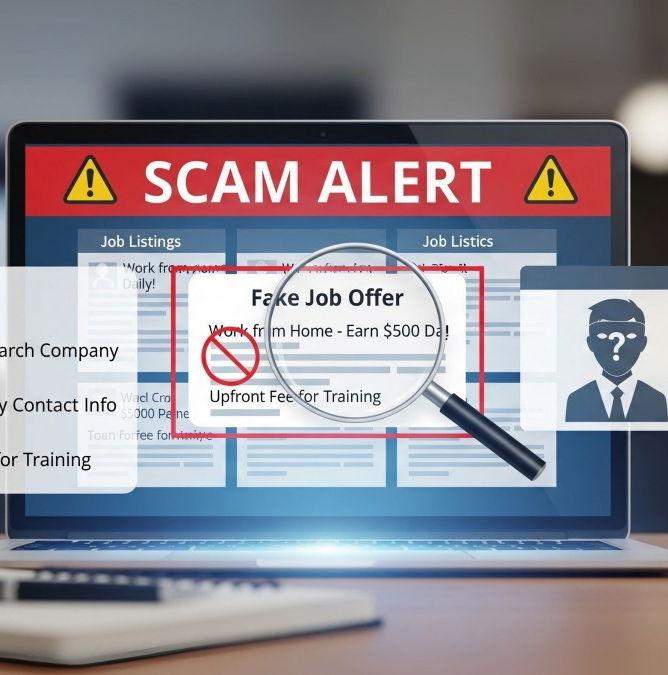
Searching for employment online can make it easier to discover opportunities, but job seekers should also be aware of employment scams.
Scammers may advertise fake vacancies, pretend to represent legitimate companies or ask applicants for money or sensitive information.
Knowing the warning signs can help you protect yourself while searching for work.
1. Be Careful When Someone Requests Payment
One of the biggest warning signs is being asked to pay money in exchange for a job opportunity.
Be particularly cautious if someone asks you to pay for:
- A job application
- An interview
- Guaranteed employment
- Recruitment
- Training that was not mentioned in the original vacancy
- Equipment that must supposedly be purchased before starting work
- A job offer
Do not assume that a job is legitimate simply because the person claims to represent a well-known company.
2. Verify the Employer
Before applying, check whether the company actually exists.
Look for the employer’s official website and compare the vacancy information with what you have received.
Check:
- Company name
- Official website
- Careers page
- Contact information
- Job title
- Application instructions
If a vacancy claims to come from a large company but cannot be found through the company’s official recruitment channels, take extra care.
3. Check the Email Address
Pay attention to the email address used by the person contacting you.
A legitimate company will often use an email address connected to its official domain.
Be cautious when someone claiming to represent a major organisation uses a personal email address or an unusual domain.
However, an email address alone does not prove whether an opportunity is legitimate. Always verify the vacancy independently.
4. Be Careful With “Guaranteed Jobs”
Be suspicious of anyone who promises that you are guaranteed to get a job without going through a normal recruitment process.
Legitimate employers generally need to assess candidates before making employment decisions.
Statements such as:
“Pay today and your job is guaranteed”
should be treated as a major warning sign.
5. Don’t Share Sensitive Information Unnecessarily
Job seekers may need to provide certain information during a legitimate recruitment process, but you should be careful about sharing sensitive information too early.
Avoid giving strangers unnecessary access to information such as:
- Banking PINs
- Online banking passwords
- One-time passwords
- Card PINs
- Passwords
- Security answers
Never share an OTP or banking password with someone claiming to be a recruiter.
6. Be Careful With WhatsApp Job Offers
WhatsApp is widely used for communication, including recruitment, but scammers can also use messaging platforms to impersonate employers.
Be cautious if someone:
- Contacts you unexpectedly about a job.
- Offers employment without reviewing your application.
- Requests payment.
- Sends suspicious links.
- Asks for sensitive banking information.
- Pressures you to respond immediately.
Verify the opportunity through the employer’s official website before continuing.
7. Check the Application Link
Before clicking an application link, check where it takes you.
If a vacancy claims to be from a particular company, compare the application website with the company’s official website.
Be especially careful if the link:
- Looks unrelated to the employer.
- Requests payment.
- Requests banking credentials.
- Downloads unexpected files.
- Requests unnecessary personal information.
When possible, navigate to the employer’s official website yourself rather than relying only on a link sent to you.
8. Watch Out for Unrealistic Job Offers
A vacancy promising extremely high earnings for very little work should be investigated carefully.
Examples of warning signs include:
- Very high income with no experience required
- Guaranteed earnings
- Immediate employment
- No interview or screening
- Pressure to recruit other people
- Requests for upfront payments
An attractive salary does not automatically mean a job is fake, but unusual claims deserve verification.
9. Don’t Let Anyone Pressure You
Scammers often create a sense of urgency.
They may tell you:
- “You must pay today.”
- “This is your last chance.”
- “Your position will be given to someone else.”
- “Send your documents immediately.”
Take time to verify the opportunity before making a decision.
A legitimate opportunity should not require you to ignore obvious warning signs simply because you are afraid of losing the position.
10. Verify Before You Apply
Before submitting an application, ask yourself:
Does the company exist?
Can I find the vacancy on the employer’s official website?
Is the application process clear?
Am I being asked to pay money?
Am I being asked for sensitive banking information?
Does the contact information appear legitimate?
If something does not seem right, investigate further before continuing.
What to Do If You Suspect a Job Scam
If you believe a vacancy may be fraudulent:
- Stop communicating with the suspected scammer.
- Do not send money.
- Do not provide passwords, PINs or OTPs.
- Do not click suspicious links.
- Keep screenshots and relevant messages.
- Verify the vacancy directly with the company.
- Report suspected fraud to the appropriate authorities or platform.
If you have already shared banking information or sent money, contact your bank immediately using its official contact channels.
How ALLjobs Helps Job Seekers
ALLjobs South Africa aims to help job seekers discover employment opportunities and useful career information.
However, job seekers should always verify important vacancy information before applying.
Where a vacancy provides an application link, applicants should check that they are being directed to the appropriate employer or recruitment platform.
ALLjobs does not guarantee employment.
Final Thoughts
Job scams can be difficult to identify because scammers may copy company names, logos and vacancy descriptions from legitimate organisations.
The safest approach is to slow down, verify the employer and never pay money simply because someone promises you employment.
Protect your personal information, be careful with unexpected job offers and use official employer channels whenever possible.
A good job search should not require you to compromise your financial security or sensitive information.