
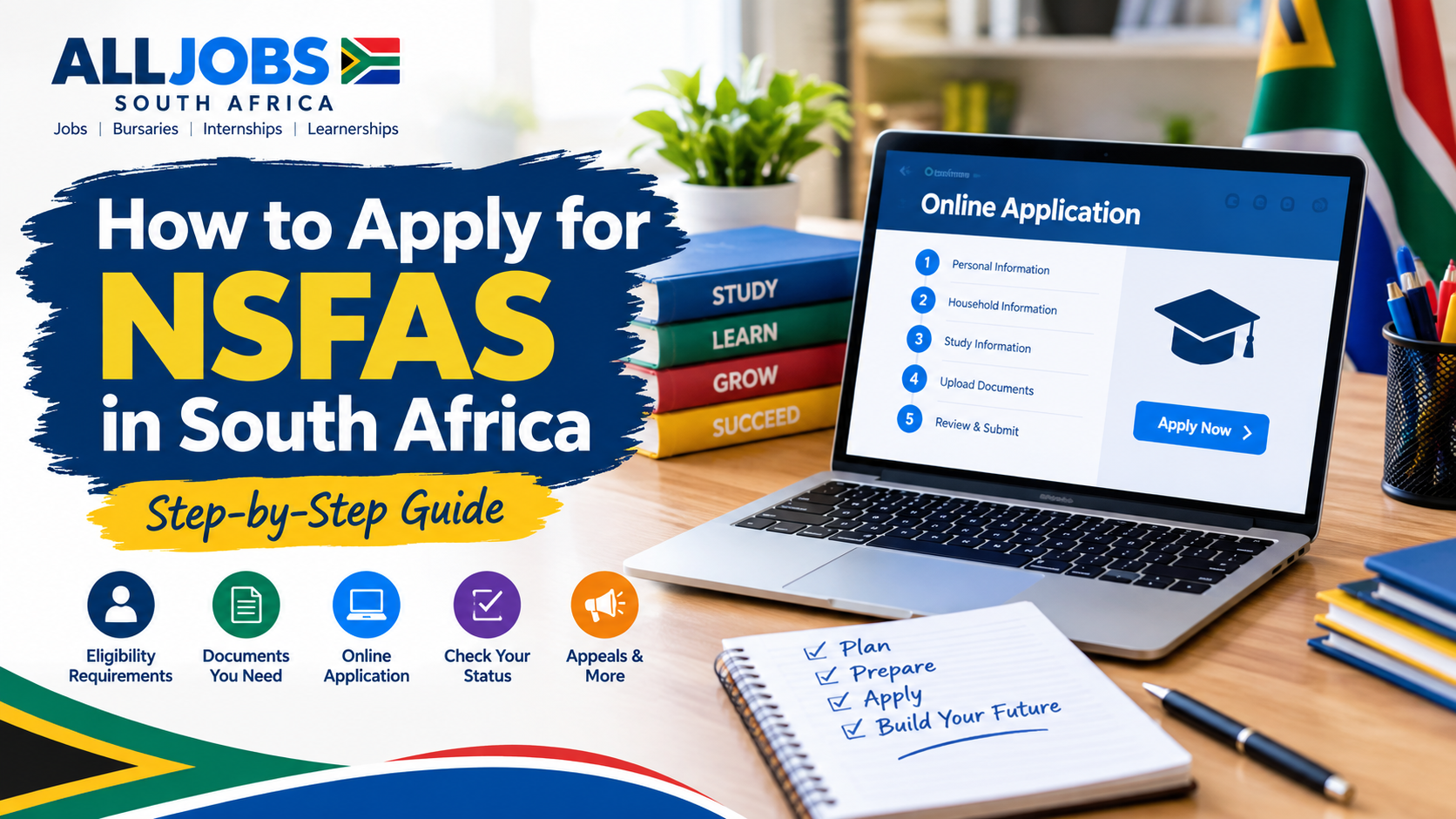
The National Student Financial Aid Scheme (NSFAS) is one of the main sources of financial support available to eligible students in South Africa. It provides funding to qualifying students who want to study at approved public universities and TVET colleges but may not have the financial resources to pay for their studies.
For many students, understanding how NSFAS works is just as important as finding a course or choosing an institution. An application can involve creating a profile, providing personal and household information, submitting supporting documents, monitoring your application status and responding to requests from NSFAS.
This guide explains how to apply for NSFAS step by step, who may qualify, what documents may be required, how the application process works, what happens after submitting an application and what to do if your application is unsuccessful.
Important: NSFAS application requirements, funding rules and application periods can change from one academic year to another. Always check the latest information on the official NSFAS website before submitting an application.
Table of Contents
1. What Is NSFAS?
NSFAS stands for the National Student Financial Aid Scheme. It is a South African government student financial aid scheme that provides funding to eligible students who meet the applicable requirements.
NSFAS is particularly important for students from households that cannot afford the full cost of tertiary education.
Funding is linked to the applicable NSFAS rules for the academic year and the institution and qualification being pursued. Students should therefore avoid assuming that every applicant will receive exactly the same benefits.
NSFAS applications are completed online through the official NSFAS platform.
For the current application process, students can access the official NSFAS website and the myNSFAS online platform.
myNSFAS online application portal
2. Who Can Apply for NSFAS?
NSFAS eligibility depends on several factors, including citizenship or residency status, household income, the type of institution and qualification, and other applicable funding rules.
According to the current NSFAS information, the bursary is available to eligible South African citizens and permanent residents who meet the applicable requirements. The current published household-income threshold is R350,000 per year, while the threshold for persons living with disabilities is R600,000 per year.
Students should not rely only on the income amount when deciding whether to apply. Other eligibility conditions also apply.
For example, NSFAS states that some students may not qualify where they are studying at a private institution or pursuing qualifications that do not meet the applicable approval or accreditation requirements.
The safest approach is to check the current NSFAS eligibility rules for the academic year in which you are applying.
3. NSFAS Bursary and NSFAS Student Loan
NSFAS also has a student loan scheme for students who fall within the applicable income range for the loan rather than the bursary.
The current NSFAS information distinguishes between the bursary and student loan based partly on household income.
For the published current rules:
- The NSFAS bursary has a household-income threshold of up to R350,000 per year.
- For persons living with disabilities, the published bursary income threshold is R600,000 per year.
- The NSFAS student loan is aimed at applicants whose household income falls within the applicable middle-income range.
The loan is different from a bursary because it involves a loan arrangement and repayment obligations under the applicable terms.
Students should therefore read the information provided by NSFAS carefully instead of assuming that all NSFAS funding is a bursary.
4. What Does NSFAS Funding Cover?
One of the most important questions students ask is what NSFAS actually pays for.
Under the current NSFAS information, bursary funding can cover areas such as:
- Registration
- Tuition fees
- Learning materials
- Living allowance
- Personal-care allowance
- Transport or accommodation, subject to the applicable rules
The exact support available can depend on the student’s circumstances, institution and NSFAS funding conditions.
This means students should not automatically assume that receiving NSFAS funding means that every expense will be paid.
Accommodation is another area where students should pay attention to the latest NSFAS rules and approved accommodation arrangements.
NSFAS has also warned beneficiaries about accommodation-related fraud and states that beneficiaries should not be charged fees simply to access NSFAS-funded accommodation.
5. NSFAS Eligibility Requirements
Before starting an application, prospective students should check whether they appear to meet the applicable requirements.
Important factors can include:
South African citizenship or permanent residency
The current NSFAS application information includes South African citizens and permanent residents who meet the relevant conditions.
Household income
Household income is an important part of NSFAS financial eligibility.
For the current published bursary rules, the household-income limit is R350,000 per year, with a R600,000 limit for persons living with disabilities.
Institution
NSFAS funding is linked to approved public universities and TVET colleges and applicable qualifications.
Students should check whether their chosen institution and qualification fall within the current NSFAS funding rules.
Qualification
Not every programme automatically qualifies for NSFAS funding. The qualification must meet the applicable requirements.
This is why it is important to check the current NSFAS information rather than relying on old social-media posts or information from previous application cycles.
6. Documents You May Need
One of the best ways to avoid delays is to prepare your documents before starting the application.
NSFAS identifies documents that may be required depending on the applicant’s circumstances.
These can include:
- A copy of the student’s ID or birth certificate
- Parent or guardian identification documents where applicable
- Spouse identification documents where applicable
- Proof of income where applicable
- Required NSFAS consent or declaration forms
- Disability documentation where applicable
- Orphan or vulnerable-child documentation where applicable
- Other supporting documents requested by NSFAS
The NSFAS FAQ confirms that documents such as student identification, parent/guardian/spouse identification and proof of income may be required.
However, students should not assume that every applicant needs to upload exactly the same documents.
NSFAS explains that the application system can generate a list of required documents based on the applicant’s circumstances.
Prepare your documents before applying
Before beginning, create a folder on your phone or computer containing clear copies of the documents you may need.
Check that:
- Your documents are readable.
- Names and ID numbers are visible.
- Documents are not cut off.
- You upload the correct document in the correct section.
- You follow the file requirements displayed by the NSFAS system.
7. How to Create a myNSFAS Account
The first step for a new applicant is to access the official NSFAS platform.
Avoid using links sent through WhatsApp groups, Facebook comments or unknown websites.
Go directly to the official NSFAS website.
From there, access the myNSFAS platform.
The current myNSFAS portal provides options to log in, create a profile and recover account access.
When creating your profile, make sure the information you enter is accurate.
Use an email address and cellphone number that you can access because NSFAS may use your contact information for communication.
Keep your login details secure and do not give your password to another person.
8. How to Apply for NSFAS Step by Step
Once you have created your myNSFAS profile, you can begin the application process.
Step 1: Visit the official NSFAS website
Go directly to the NSFAS website rather than relying on links from unofficial sources.
Step 2: Access myNSFAS
Select the relevant option to create a profile or log into your existing account.
Step 3: Create your profile
New applicants need to provide the information requested by the NSFAS system.
Make sure your personal details match your official documents.
Step 4: Start your application
After creating your profile, follow the application instructions provided on the portal.
Step 5: Enter your personal information
Check your name, surname, ID number and contact information carefully.
A mistake in your personal details can create problems later.
Step 6: Provide household information
NSFAS uses information about your household and financial circumstances when assessing financial eligibility.
Provide truthful information and use the correct supporting documents where requested.
Step 7: Provide study information
Enter the information requested about the institution and qualification you intend to study.
Make sure the information is correct.
Step 8: Upload required documents
Upload the documents requested by the application system.
Do not upload random documents simply because you think they might be useful.
Follow the instructions shown on the portal.
Step 9: Review the application
Before submitting, go through the application carefully.
Check:
- Personal information
- Contact details
- Household information
- Study information
- Uploaded documents
- Consent and declaration information
Step 10: Submit
Once you are satisfied that the information is correct and all required documents have been provided, submit the application.
Do not stop at saving the application if the system still requires you to submit it.
9. How to Upload Supporting Documents
Uploading documents correctly is an important part of the NSFAS application.
If NSFAS asks you for a document, make sure you upload the correct document.
For example, if the system asks for a parent’s identification document, do not upload your own ID instead.
Applicants with disabilities may have additional documentation requirements. NSFAS currently identifies a Disability Annexure form and supporting medical information for applicable applicants.
Applicants should also check whether NSFAS requests additional documents after the initial application.
Do not ignore document requests
If your myNSFAS account indicates that documents are missing, log into your account and check what is required.
NSFAS currently instructs applicants who receive requests for supporting documents to log into their myNSFAS account and upload the required documents.
10. How to Submit Your NSFAS Application
Before submitting, take a few minutes to review everything.
Ask yourself:
Is my personal information correct?
Have I provided accurate household information?
Have I uploaded every document requested?
Is my contact information correct?
Have I followed all the instructions on the portal?
After submitting, keep evidence that your application was successfully submitted.
You should also continue checking your myNSFAS account for updates.
11. How to Check Your NSFAS Application Status
Submitting an application is not the end of the process.
Applicants should regularly log into their myNSFAS account to check for changes.
Your application may move through different stages while NSFAS assesses your information.
Do not rely only on social media posts or messages from other students to determine whether your application has been approved.
Your own myNSFAS account is an important place to check your application information.
12. Understanding Common NSFAS Application Statuses
Students may see different application statuses during the assessment process.
Some commonly used terms include:
Application Submitted
This generally indicates that your application has been received and is being processed.
Documents Missing
This indicates that NSFAS requires additional information or documentation from you.
Under Review
Your application is undergoing assessment.
Approved
Your application has been approved for funding, subject to the applicable conditions.
Rejected
Your application was not approved and a reason may be provided.
The exact meaning of a status should be considered together with any instructions displayed in your myNSFAS account. NSFAS provides status information and encourages applicants to check for further actions required.
13. What to Do If NSFAS Requests More Documents
Do not panic if NSFAS requests additional documents.
A request for documents does not automatically mean that your application has been rejected.
Log into your myNSFAS account and read the request carefully.
Identify:
- Which document is required.
- Whether the document needs to be completed or signed.
- Where it must be uploaded.
- Whether there is a deadline.
- Whether the document is clear and readable.
NSFAS may request different documents depending on the applicant’s circumstances.
14. What Happens If Your NSFAS Application Is Rejected?
If your application is rejected, first read the reason provided.
Do not immediately assume that the decision cannot be challenged.
Depending on the reason and the applicable NSFAS rules, you may be able to submit an appeal.
Possible reasons can relate to financial eligibility, academic or institutional requirements, missing information or other funding conditions.
The correct response depends on the specific reason shown on your application.
15. How to Appeal an NSFAS Decision
Applicants who are eligible to appeal can submit an appeal through their myNSFAS profile.
NSFAS currently states that an appeal should be submitted within 30 days of receiving the application results, subject to the applicable appeal rules.
If your financial circumstances have changed, you may need to provide evidence supporting the change.
For example, NSFAS identifies circumstances such as a change in household financial circumstances or the death or incapacitation of a key household income contributor as situations that may be considered under the relevant appeal rules.
Do not submit an appeal without understanding why your application was rejected.
Start with the rejection reason and then provide the information or evidence relevant to that reason.
16. NSFAS for TVET College Students
NSFAS is not only for university students.
Eligible students at public TVET colleges can also apply for NSFAS funding, subject to the applicable rules.
NSFAS provides information specifically for TVET students, including application cycles for different periods such as semesters and trimesters.
If you are planning to study at a TVET college, check the application period that applies to your programme and study period.
Do not assume that university and TVET application arrangements are always identical.
17. Common NSFAS Application Mistakes to Avoid
1. Using unofficial websites
Always start from the official NSFAS website.
2. Providing incorrect information
Never provide false household or personal information simply because you believe it will increase your chances of receiving funding.
3. Uploading the wrong documents
Check every upload before submitting.
4. Ignoring your myNSFAS account
Important requests may require action.
5. Waiting until the deadline
Technical problems, missing documents and other issues can take time to resolve.
6. Applying through someone who promises guaranteed funding
Nobody should be able to guarantee that NSFAS will approve your application.
7. Paying someone for an NSFAS application
Students should be cautious about anyone asking for money to “secure” NSFAS funding.
Use the official NSFAS application channels.
18. How to Protect Yourself From NSFAS Scams
Students looking for funding can become targets for scams because many applicants urgently need financial assistance.
Be careful when someone:
- Promises guaranteed NSFAS approval.
- Requests your password.
- Requests your banking PIN.
- Asks for payment to submit an application.
- Sends you to an unfamiliar website.
- Claims to work for NSFAS without providing verifiable information.
- Asks you to send personal documents through an unknown WhatsApp number.
Use the official NSFAS website and myNSFAS platform whenever possible.
NSFAS also provides official communication channels for reporting fraud and unethical conduct.
19. NSFAS Application Checklist
Before submitting your application, use this checklist:
Personal information
- ID number checked
- Full name checked
- Contact number checked
- Email address checked
Household information
- Parent/guardian information checked where applicable
- Household financial information provided accurately
- Supporting information available
Documents
- Student ID/birth certificate where required
- Parent/guardian/spouse documents where required
- Proof of income where required
- Consent/declaration forms where required
- Disability documentation where applicable
- Other requested documents uploaded
Final application
- Institution information checked
- Qualification information checked
- Application reviewed
- Required documents uploaded
- Application submitted
- Submission/status information saved
- myNSFAS account checked regularly
20. NSFAS and Other Bursaries & Funding Opportunities
NSFAS is one of the major sources of student financial support in South Africa, but it is not the only option available to students looking for help with the cost of their studies.
There are many other bursaries and funding opportunities offered by companies, foundations, government departments, universities, professional organisations and other institutions. These opportunities can have different eligibility requirements, closing dates, fields of study and application processes.
Some bursaries are aimed at specific study areas such as engineering, accounting, medicine, education, information technology and the built environment. Others may be available to students who meet particular academic, financial, geographic or community-related requirements.
If you are looking beyond NSFAS, visit the ALLJOBS Bursaries & Funding section to explore bursaries and other funding opportunities that may be available to South African students.
You can also read our detailed guide, How to Find Bursaries in South Africa: Where to Apply & What You Need, which explains where students can search for bursaries, what requirements to look for and what information they may need when preparing an application.
Exploring different funding options can help students understand the range of opportunities available instead of relying on only one source of financial support. However, each opportunity has its own requirements, so always check the information and application instructions provided by the organisation offering the funding.
Explore More Bursaries and Funding Opportunities
Looking for additional ways to fund your studies?
View ALLJOBS Bursaries & Funding Opportunities
You can also continue your search with our guide:
How to Find Bursaries in South Africa: Where to Apply & What You Need
21. Frequently Asked Questions About NSFAS
Can I apply for NSFAS online?
Yes. NSFAS applications are completed through the official NSFAS online system during the applicable application period.
Is NSFAS only for university students?
No. Eligible students at public TVET colleges can also receive NSFAS funding, subject to the applicable requirements.
How much household income is allowed?
The current published NSFAS bursary threshold is R350,000 per year, while the published threshold for persons living with disabilities is R600,000 per year. These requirements should be checked against the rules for the academic year in which you apply.
Does NSFAS pay tuition fees?
Under the current bursary information, NSFAS funding covers tuition and registration, subject to the applicable funding rules.
Does NSFAS pay for accommodation?
Accommodation support can form part of NSFAS funding subject to the applicable rules and arrangements.
Students should check the current NSFAS accommodation requirements rather than assuming that any private accommodation will automatically be funded.
Can I apply if I am studying at a private college?
The current NSFAS application information states that students studying at private institutions do not qualify for NSFAS bursary funding under those rules.
What happens if I forget my myNSFAS password?
Use the account recovery options available on the official myNSFAS platform rather than creating another account unnecessarily.
What if my NSFAS application is rejected?
Read the rejection reason carefully. If you meet the requirements for an appeal, you may be able to submit an appeal through myNSFAS.
Can I apply for other bursaries if I have applied for NSFAS?
You can search for other funding opportunities, but you should carefully check the rules of each bursary and disclose funding information where required.
22. Final Tips Before Applying for NSFAS
Applying for student funding should not be treated as something to complete in a few minutes without checking the information.
Before submitting your application:
Start early. Give yourself enough time to find missing documents and correct mistakes.
Use official sources. NSFAS requirements can change, so old Facebook posts and outdated articles may contain information that no longer applies.
Check your information. Your ID number, personal details, household information and study information should be accurate.
Keep your account secure. Never give your password or sensitive account information to strangers.
Monitor your application. After submitting, continue checking your myNSFAS account for updates and requests.
Do not ignore document requests. If NSFAS asks for additional information, deal with the request as soon as possible.
Understand your funding. Approval for NSFAS funding does not mean that every possible student expense will automatically be covered.
Keep looking for opportunities. NSFAS is one important funding route, but students can also explore other bursaries and funding opportunities.
23. Official NSFAS Application Website
Students should use the official NSFAS website when applying for funding or checking the latest requirements.
Official NSFAS website:
NSFAS – National Student Financial Aid Scheme
Online application portal:
myNSFAS – Online Application Portal
Before submitting an application, check the official website for the latest application dates, eligibility requirements, supporting documents and instructions for the relevant academic year.
Related Guide
Looking for other ways to fund your studies?
Read our guide:
How to Find Bursaries in South Africa: Where to Apply & What You Need
The guide explains where students can search for bursaries, what requirements to look for and how to prepare when applying for different funding opportunities.
ALLJOBS South Africa
ALLJOBS South Africa provides information about jobs, bursaries, internships, learnerships and other opportunities available to South Africans.
For funding applications, always use the official application channel provided by the organisation offering the opportunity and check the latest requirements before applying.